
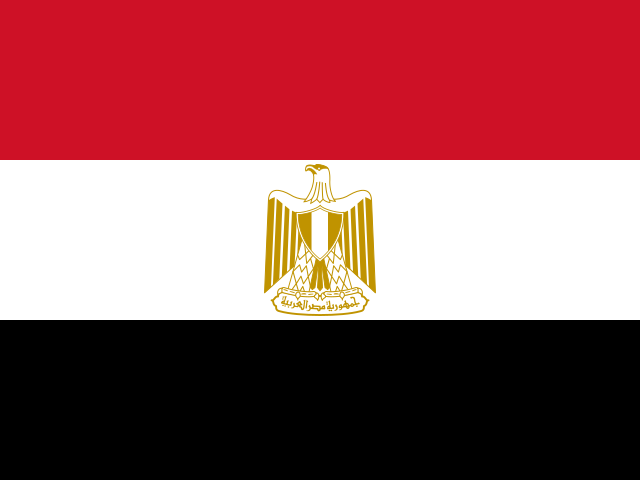
Supports the negotiation of a legally binding instrument.
Egypt is a state signatory to the Convention on Certain Conventional Weapons (CCW), and has participated in a number of CCW meetings on autonomous weapons systems since 2014. Egypt supports the negotiation of a legally binding instrument on autonomous weapons systems. Egypt is a member of the African Group and a member of the Non-Aligned Movement (NAM), both of which support the negotiation of a legally binding instrument on autonomous weapons systems.
In December 2025, Egypt voted in favour of UN General Assembly Resolution 80/57 on lethal autonomous weapons systems. Mindful of the challenges and concerns autonomous weapons systems raise from humanitarian, legal, security, technological and ethical perspectives, Resolution 80/57 stresses the urgent need for the CCW to address the challenges and concerns posed by autonomous weapons systems, and calls upon the High Contracting Parties of the CCW to ‘work towards completing the set of elements for an instrument being developed within the mandate of the Group of Governmental Experts, with a view to future negotiation.’
At the 79th UN General Assembly First Committee in October 2024, Egypt voted in favour of Draft Resolution L.77 on lethal autonomous weapons systems. Draft Resolution L.77 raises concerns about the ‘negative consequences and impact of autonomous weapon systems on global security and regional and international stability’ and stresses ‘the importance of the role of humans in the use of force to ensure responsibility and accountability and for States to comply with international law.’ It also notes ‘the repeated calls by the Secretary-General to urgently conclude negotiations of a legally binding instrument with prohibitions and regulations for autonomous weapons systems, in line with a two-tier approach.’ The Resolution will convene open informal consultations in 2025 over two days in New York, ‘to consider the report of the Secretary-General in full complementarity with and in a manner that supports the fulfilment of the mandate of the Group of Governmental Experts in order to further the international community’s understanding of the issues involved by discussing the full range of views received, including proposals and relevant aspects raised in the report that may thus far not have been discussed in detail in the Group of Governmental Experts.’
Speaking at the UN General Assembly First Committee in October 2024, Egypt expressed that it is ‘deeply concerned’ about the development and use of autonomous weapons, and reiterated its support for a two-tier approach.[1]Statement by Egypt, 79th UNGA First Committee, 25 October 2024
Egypt made a submission to the UN Secretary-General pursuant to Resolution 78/241 on autonomous weapons systems in May 2024.
In December 2023, Egypt voted in support of UN General Assembly Resolution 78/241 on lethal autonomous weapons systems. Resolution 78/241 stressed the ‘urgent need for the international community to address the challenges and concerns raised by autonomous weapons systems’, and mandated the UN Secretary-General to prepare a report, reflecting the views of member and observer states on autonomous weapons systems and ways to address the related challenges and concerns they raise from humanitarian, legal, security, technological and ethical perspectives and on the role of humans in the use of force. Explaining its vote, Egypt stated that it ‘attaches great importance to advancing the efforts of the United Nations on addressing the risks associated with lethal autonomous weapons systems (LAWS). Fully autonomous weapons pose a threat to international peace and security and raise a number of legal, humanitarian, and ethical concerns that have to be addressed. The United Nations disarmament machinery must actively address the increasing threats and risks associated with an emerging category of weapons that could be able to activate itself, select its targets, and take a human life. Even if we assume that an algorithm can determine what is legal under international humanitarian law, it can never determine what is ethical.’’[2]Statement by Egypt, UNGA First Committee, 01 November 2023, https://media.un.org/en/asset/k1t/k1t5mdoxcp, Please note that this link leads to the full recording of the relevant meeting
Egypt also stated at First Committee in 2023 that it ‘attaches a great importance to the discussions of Lethal Autonomous Weapons, due to the risks it poses to international peace and security, and we stress the centrality of human responsibility for such weapons as well as the authorization of lethal weapons, regardless of the type of weapon systems that delivers the force.’ [3]Statement by Egypt, https://docs-library.unoda.org/General_Assembly_First_Committee_-Seventy-Eighth_session_(2023)/Egypt.pdf ,UNGA First Committee, 23 October 2023
At the 77th UN General Assembly First Committee meeting in October 2022, Egypt said that ‘there are several domains which have a direct impact on international security that are left without any internationally agreed rules to prevent them from turning into a series of arms races and armed conflicts,’ including in the area of autonomous weapons systems.[4]Statement by Egypt, 77th UN General Assembly First Committee, 24 October 2022, https://media.un.org/en/asset/k1s/k1s8hkl4pp; please note that this link leads to the full recording & transcript of … Continue reading
During the third session of the 2021 meeting of the CCW Group of Governmental Experts on LAWS, the African Group said that autonomous weapon systems raise a number of ‘ethical, legal, moral and technical questions’, and that it looks forward to ‘concrete policy recommendations including elements of a legally binding instrument, stipulating prohibitions and regulations’ on autonomous weapon systems.[5]Statement by the African Group, CCW Group of Governmental Experts meeting on Lethal Autonomous Weapon Systems, 3 December 2021: http://149.202.215.129:8080/s2t/UNOG/LAWS3-03-12-2021-AM_mp3_en.html; … Continue reading
In a statement during the CCW Group of Governmental Experts on Lethal Autonomous Weapons Systems (GGE on LAWS) on 9 April 2018, Egypt stated that it is ‘of the view that a legally binding instrument against the development and manufacture of such weapon systems is urgent…as well as the regulation of existing systems that fall within this mandate’.[6]Statement by Egypt, CCW Group of Governmental Experts on LAWS, 9 April 2018, … Continue reading.
References
| ↑1 | Statement by Egypt, 79th UNGA First Committee, 25 October 2024 |
|---|---|
| ↑2 | Statement by Egypt, UNGA First Committee, 01 November 2023, https://media.un.org/en/asset/k1t/k1t5mdoxcp, Please note that this link leads to the full recording of the relevant meeting |
| ↑3 | Statement by Egypt, https://docs-library.unoda.org/General_Assembly_First_Committee_-Seventy-Eighth_session_(2023)/Egypt.pdf ,UNGA First Committee, 23 October 2023 |
| ↑4 | Statement by Egypt, 77th UN General Assembly First Committee, 24 October 2022, https://media.un.org/en/asset/k1s/k1s8hkl4pp; please note that this link leads to the full recording & transcript of the relevant meeting. |
| ↑5 | Statement by the African Group, CCW Group of Governmental Experts meeting on Lethal Autonomous Weapon Systems, 3 December 2021: http://149.202.215.129:8080/s2t/UNOG/LAWS3-03-12-2021-AM_mp3_en.html; please note that this link leads to the full recording & transcript of the relevant meeting. |
| ↑6 | Statement by Egypt, CCW Group of Governmental Experts on LAWS, 9 April 2018, https://conf.unog.ch/digitalrecordings/index.html?guid=public/61.0500/2DCCE4C0-9A85-4EB2-A384-5C7E59A8FF09_15h11&position=2191 |